Codependency: signs and how to stop being codependent
Codependency is a state in which the life of someone close to a person with an addiction — a wife, husband or parent — starts to revolve around that person's drinking or drug use: control, rescuing, fear and guilt push out your own life. You can stop being codependent, not by finding the "right words" for them, but by working on yourself: boundaries, giving up rescuing, getting support and reclaiming your life. That is also the best chance for the person with the addiction.
Signs of codependency
- Your mood depends entirely on whether they drank or used today
- You check their phone and pockets, count bottles and money, track where they are and who with
- You pay their debts, call their work to say they are "sick", lie to relatives and the children
- You give "one last chance" again and again and threaten things you will never do
- You feel guilty for their use and believe that if you were "better", they would stop
- Friends, health, work and interests have faded — there is no energy left for yourself
- Constant anxiety, poor sleep, headaches, exhaustion, bursts of anger and tears
- You feel ashamed and hide what is happening, and taking care of yourself feels like betrayal
What to do to stop being codependent
What to do
- Accept one simple fact: you cannot control another person's use — only your own behaviour.
- Take back at least one piece of your own life: sleep, a doctor's appointment, work, a friend, exercise.
- Choose one or two boundaries you will definitely hold, and state them calmly — without shouting or threats.
- Get support: a consultation with a specialist, support groups for families of people with addictions (such as Al-Anon or Nar-Anon).
- Talk to your children honestly and in a way that fits their age: Mum or Dad has an illness, and it is not their fault.
- If there is violence or threats, your safety and the children's come first — not keeping the family together.
What not to do
- Do not take on the consequences of their use: debts, missed work, explanations to their boss.
- Do not spend your life policing them: searches, surveillance and poured-out bottles change nothing but wear you down.
- Do not threaten to leave or divorce unless you are ready to do it: empty threats teach them your words mean nothing.
- Do not blame yourself: codependency is a reaction to a loved one's illness, not your weakness.
- Do not put your life on hold until "they quit".
How to stop being codependent
Codependency is not a disgrace or a personality flaw; it is a natural reaction to years spent living alongside an addiction. Anxiety that lasts for years reshapes behaviour: you live in constant readiness for disaster. That is why willpower alone is rarely enough — it takes steady work, in many ways similar to the recovery of the person with the addiction.
In the Full Return Method, work with the family and codependency is one of the six pillars. As long as relatives absorb the consequences, the addiction has everything it needs to continue. When a loved one steps out of the rescuer role, the illness loses its support — and that is often exactly what pushes the person towards treatment.
In practice we go step by step. First we look at your role: rescuer, controller, victim, "mother to a grown-up husband". Then we work out what you do in specific situations — when they are drunk, ask for money or promise it is "the last time". At the same time we rebuild your own life: health, work, friendships. Family support groups and regular support help you avoid sliding back when things at home get hard again.
If your loved one is in treatment at IsraRehab, the family is included in the programme. And if they still refuse treatment, the work with you can start now — without their participation or consent. The first consultation is free, online or in person in Israel.
Consultations for families →
What to do when your husband drinks, your son uses, and every attempt to help only makes it worse.
Treatment at IsraRehab ↗
If detox or inpatient care is needed, treatment takes place at the licensed IsraRehab centre under medical supervision.
When safety comes first
- Physical violence, threats to hurt you, weapons in the home — get to a safe place and call the police (100 in Israel).
- Violence or threats towards the children, or violence in front of them — protecting the children matters more than keeping the family together.
- If you yourself have thoughts of suicide or feel you cannot go on — get emergency help right away (101 in Israel).
- Your loved one is unconscious, not breathing or breathing very slowly after using — call 101 and do not leave them alone.
Frequently asked questions
What are the signs of codependency?
Your life revolves around someone else's use: you control, check, rescue, excuse and cover for them. Your mood depends on whether they drank today, you have no energy left for yourself, and constant anxiety, guilt and shame have become the background. If you recognise yourself in several of these, it is a reason to get support.
How do I stop being codependent?
Stop taking on the consequences of their use, set boundaries you will actually hold, and reclaim your own life — health, work, friendships. It is hard to do alone, so a specialist's consultations and family support groups help. It is a process that takes months, not a single conversation.
How do I live with an alcoholic partner without losing myself?
Separate their illness from your life. Do not pay their debts, lie for them or track their every move — and at the same time look after your health, work, children and friends. Talk about the problem directly and calmly, without empty threats. If there is violence, safety comes first.
If I stop rescuing them, won't they die?
Helping and rescuing are different things. Helping leads towards treatment: you are ready to pay for rehab, support them and be there. Rescuing makes using comfortable: money, cover stories, endless "last chances". In a life-threatening situation such as an overdose, of course call emergency services at once — that is not rescuing, it is a necessity.
Should I leave my addicted spouse?
That decision is yours alone and should not be made in panic. Recovering from codependency does not necessarily mean divorce — it means no longer living their illness. But if there is violence or a threat to you and the children, safety matters more than keeping the family together.
Related: videos
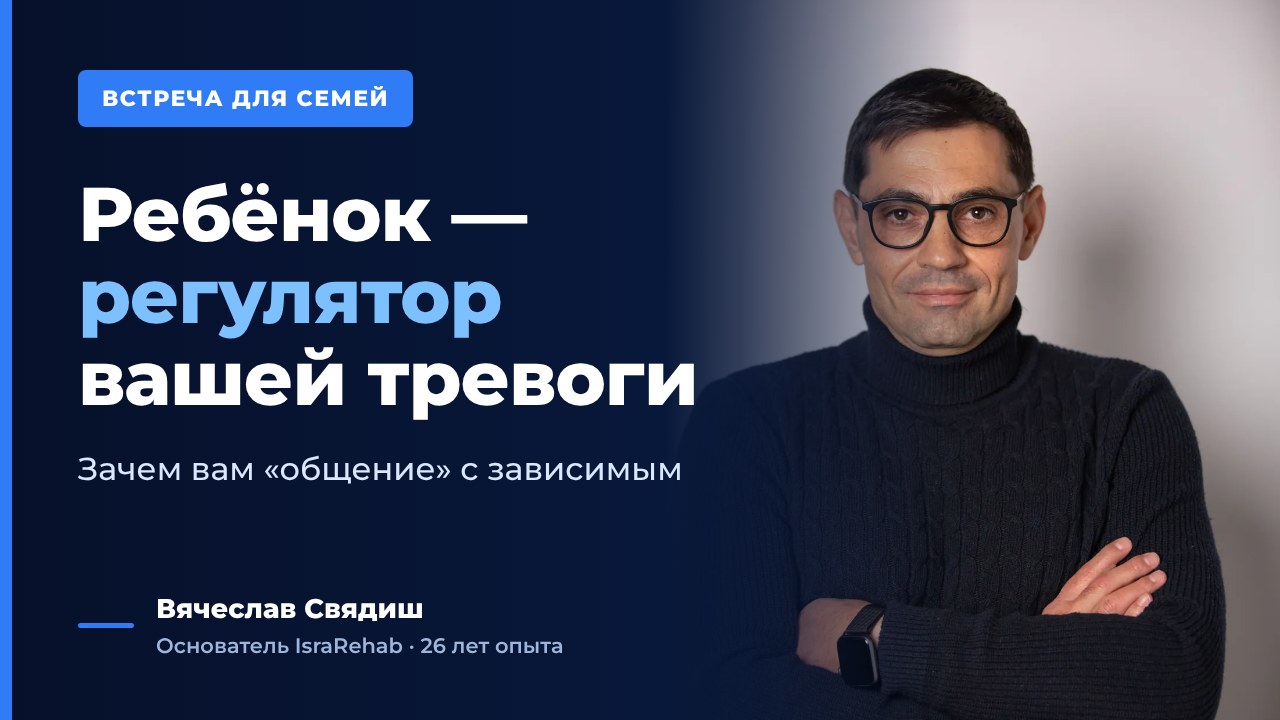 1:26:42
Online meeting for families of people with addiction
Child as an anxiety regulator
An online meeting for families about healthy communication and personal boundaries. Viacheslav Sviadish takes apart parents’ most frequent question — “how do I establish communication with my child in addiction” — and shows that behind it there is usually not concern for the child but an attempt to calm one’s own anxiety.
Watch →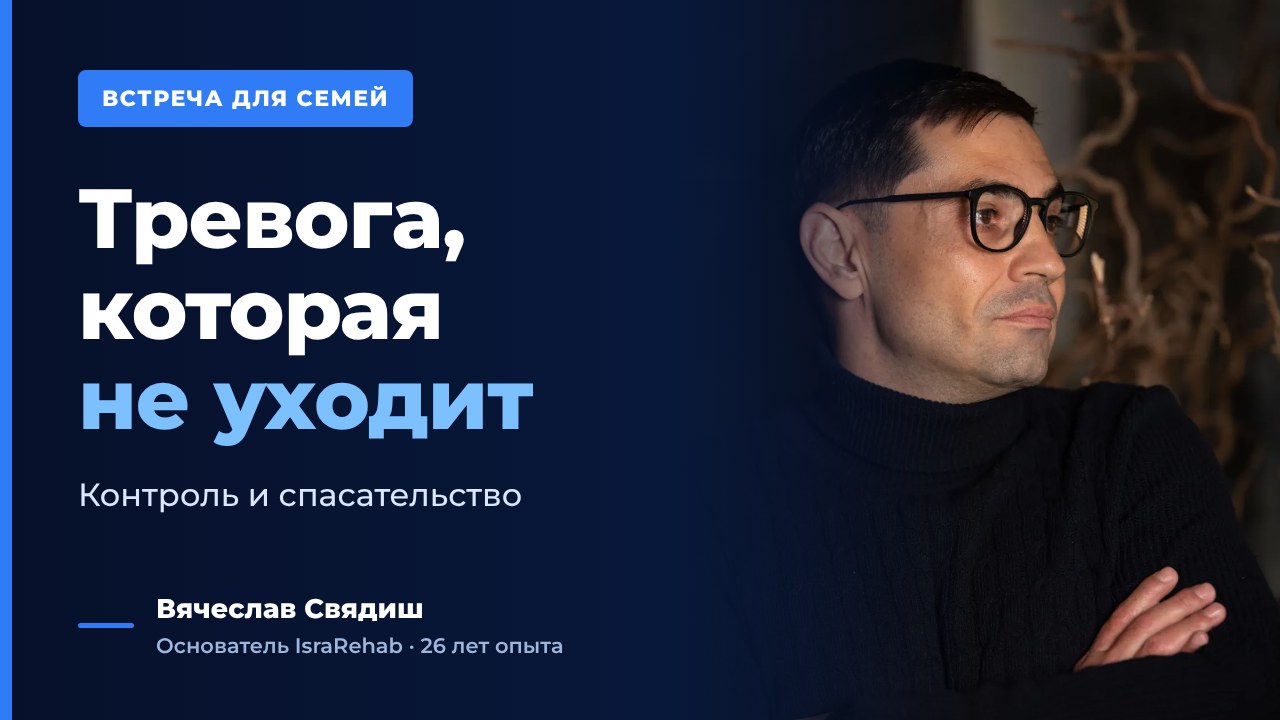 1:27:07
Online meeting for families of people with addiction
Anxiety in codependency
An online group for families of people with addiction. Viacheslav Sviadish explains why anxiety doesn’t go away even when a loved one is in rehab, how control and rescuing become a way to calm yourself, and why the way out starts with a pause and awareness. Two participants who have been through addiction themselves share their experience.
Watch →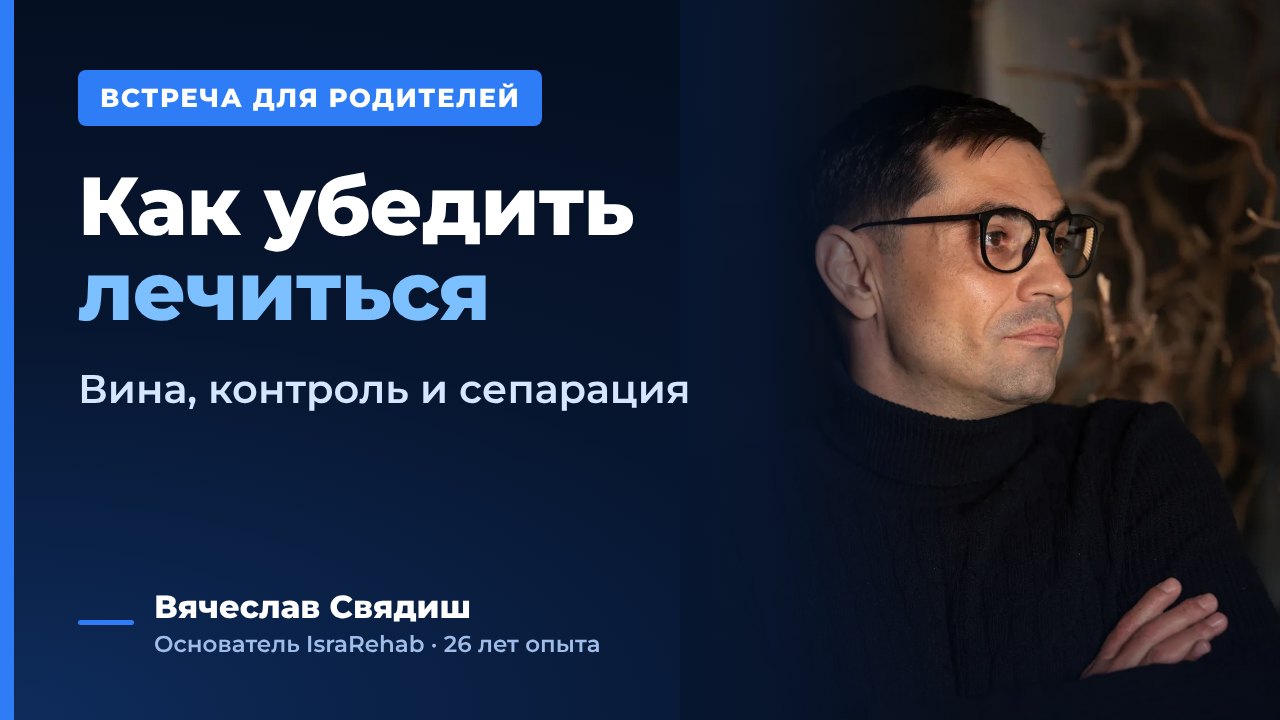 1:22:38
Online meeting for parents of people with addiction
Getting a loved one into treatment
A recording of an online meeting with parents. Viacheslav Sviadish explains why guilt and control keep both parents and children stuck in a closed cycle, and why the path to a child’s treatment begins with change in the parents themselves.
Watch →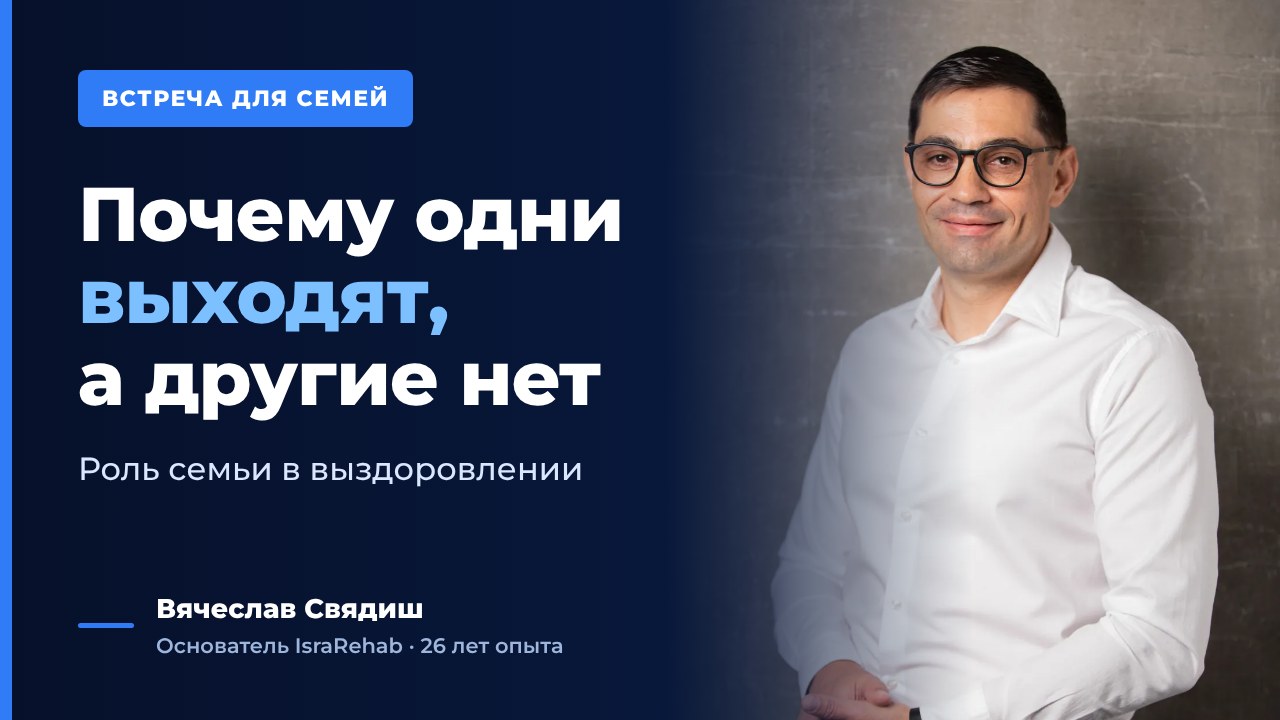 1:33:06
Online meeting for families of people with addiction
Why some recover and others don't
An online meeting for families in a tough, deliberately provocative format. Through live polls and simple metaphors — crutches after an injury, a cliff and a rope — Viacheslav Sviadish shows why helping with money often keeps a person in the illness, and why the path to recovery begins with the family's separation.
Watch →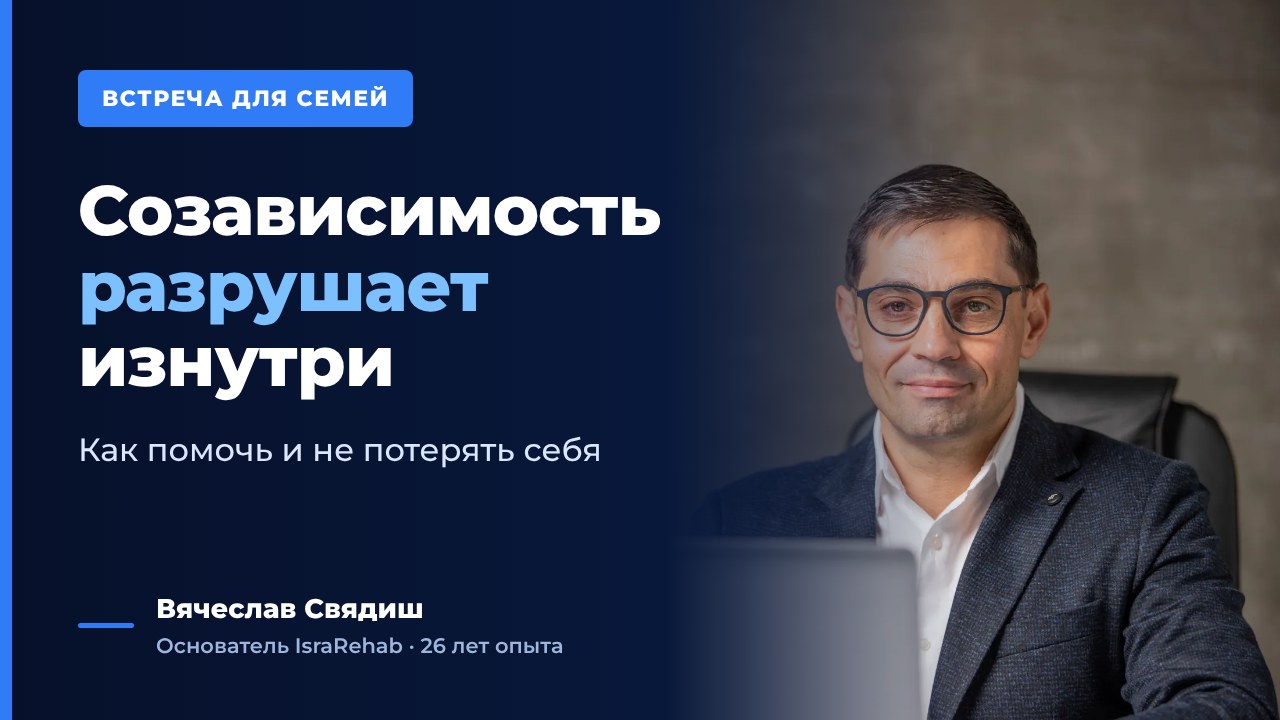 1:38:50
Online meeting for families of people with addiction
Codependency: don't lose yourself
An interactive online meeting for families. Viacheslav Sviadish explains why codependency takes shape even before a child's addiction, presents a simple “event – interpretation – emotions – reaction – result” model, and works through real situations with participants in which fear and guilt push people into the same useless actions again and again.
Watch → 1:19:53
Online group meeting for codependent family members
Being, not seeming
A recording of an online meeting for families of people with addiction. Viacheslav Sviadish explains why a codependent person lives not in reality but in their own guesses and fears, how much energy goes into “servicing” them, and how, through separation and daily practice, you can learn to tell facts from what only seems to be true.
Watch →Addictions
Alcoholism
How to recognise alcoholism in someone you love and what to do if they refuse help.
Learn more →Drug addiction
Signs of drug use in teenagers and adults, and what parents and loved ones can do.
Learn more →Gambling addiction
Online casinos, betting, debts and lies: how to recognise gambling addiction and protect your family.
Learn more →Prescription drug addiction
Sleeping pills, benzodiazepines, pregabalin and painkillers: when a prescribed medicine turns into an addiction.
Learn more →Cannabis addiction
Weed, hash, marijuana: when the "soft" drug stops being soft for the person and the family.
Learn more →Cocaine and stimulants
Cocaine, mephedrone, amphetamines: an addiction that quickly hits the mind, the heart, the finances and the family.
Learn more →